
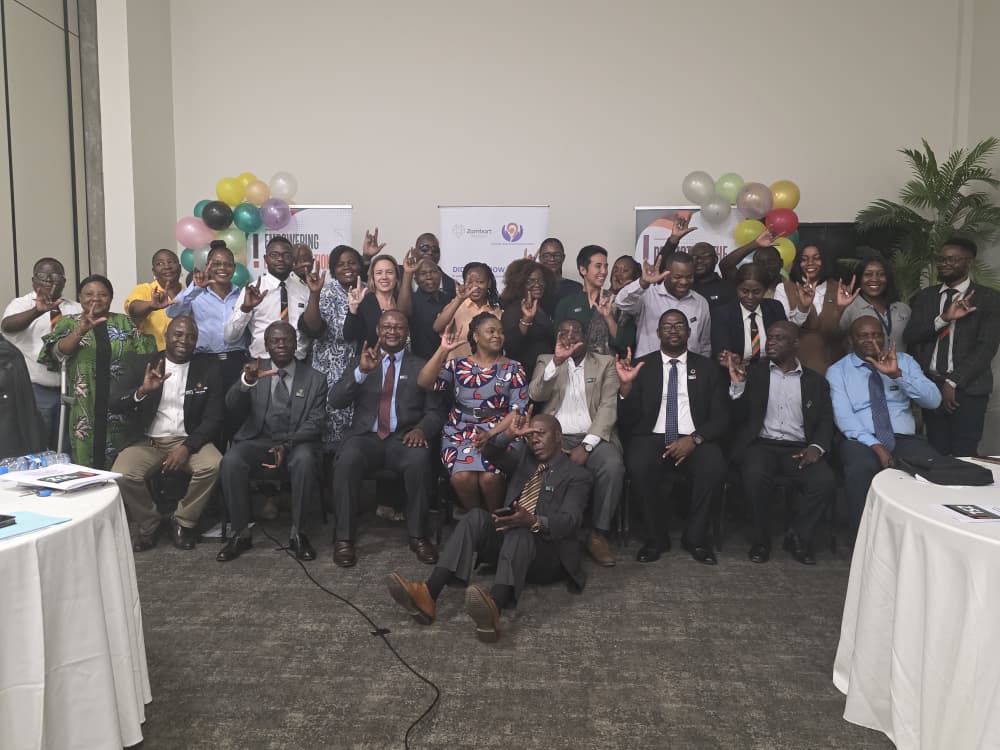
Government has officially received the Zambian Sign Language Digital Dictionary, marking a significant milestone in advancing accessible communication and promoting the inclusion of Deaf persons in national development.
Speaking at the handover ceremony, Director of Social Welfare in the Ministry of Community Development and Social Services, Mr. Morris Moono, highlighted the importance of the dictionary in improving access to social welfare services, particularly for Deaf persons seeking assistance from government service delivery points.
Mr. Moono observed that communication barriers can prevent Deaf persons from reporting abuse, explaining their circumstances, understanding available support services and participating in decisions affecting their welfare.
He particularly emphasised the need for accessible communication when providing support to Deaf children, women experiencing gender-based violence and persons requiring psychosocial support.
He further encouraged the use of the dictionary to strengthen the capacity of frontline officers and community structures to engage more effectively with Deaf clients.
He reaffirmed the Ministry’s commitment to working with ZAPD and other stakeholders to improve the accessibility and inclusiveness of social welfare services.
Meanwhile, the Director General of ZAPD, Mr. Frankson Musukwa, described the handover as an important step towards addressing communication barriers that continue to limit Deaf persons’ access to essential services, including healthcare, education, employment, justice and public information.
Mr. Musukwa noted that the freely accessible online dictionary goes beyond individual learning, providing an opportunity to strengthen communication within families, schools, workplaces, healthcare facilities and public institutions.
He called on Government ministries, educational institutions, healthcare providers, private organisations and civil society to integrate the resource into their daily operations to promote inclusive service delivery.
He further emphasised that while the dictionary represents a transformative milestone, it complements rather than replaces the need for qualified sign language interpreters and accessible public systems.
The initiative was made possible through the efforts of the Zambia Deaf Women and Youth Organisation, working in collaboration with technical and development partners, with the active participation of the Deaf community.
The handover marks an important step towards ensuring that communication is not a barrier to accessing public services and exercising fundamental rights.
As Zambia continues advancing disability inclusion, the successful utilisation of the dictionary will depend on its adoption by institutions, continued collaboration with the Deaf community and deliberate efforts to make public services accessible to everyone.